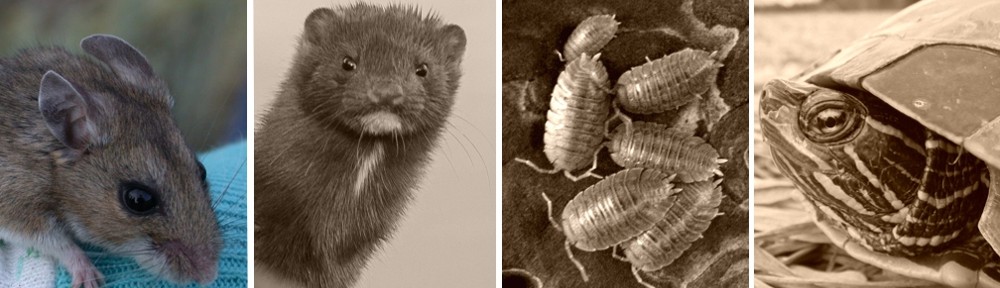
Courses I instructed during my tenure at TRU…
NRSC 3000 – Evolution and Diversity of the Vertebrates
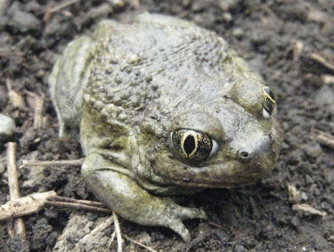 This course really should be entitled the ‘Evolution and Diversity of the Tetrapods‘ as we focus exclusively on the amphibians, reptiles, birds and mammals (our undergrads cover the fish in a different course). But, for some reason, this title seems to have stuck.
This is our department’s introductory course to wildlife, including natural history and identification. In the lectures I provided a brief overview of tetrapod anatomy and physiology, and then we went into coverage of the four tetrapod groups. This includes taxonomy and evolutionary relationships, (Darwin, anyone?) and an introduction to the amazing array of adaptations that these animals show. I also covered many of the fundamental concepts in evolutionary ecology that are becoming increasingly important in conservation. We occasionally interrupted the normal lecture schedule for gala events like the ‘Critter Competition’ and the ‘Very Best Tetrapod Day’. In the labs, Sheri Watson worked with the students to hone their field skills in animal identification, using tools such as field guides, songs and calls, shed skins (snakes!) and tracks. All in all, this was a very fun course to teach, and at the same time, it helped (I hope) the students to build a broad appreciation of the different tetrapod groups.
NRSC 4040 – Wildlife Conservation & Management I: Theory & Principles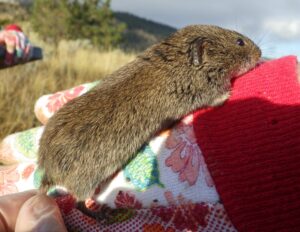
I taught two upper-level ‘sibling’ courses in wildlife management and conservation. NRSC 4040 provided the students with a grounding in the major scientific concepts in the field, and in doing so, allowed them to move further into the field of application and management within a social, human context (see NRSC 4050 below). Topics we covered in this course include island biogeography, metapopulation theory, reserve design, population viability analysis, principles of wildlife genetics, invasive species, fragmentation, wildlife habitat analyses, and the demography and extinction risk of small populations. In this course, we also conducted a small mammal trapping survey within the grasslands surrounding Kamloops. As Sheri Watson (the lab instructor) and I started this project back in 1997, we accumulated a long-term data set that undergraduates in this course used to learn how to conduct basic population and demographic analyses. Kara Atkinson (MSc 2026) used this data set as the backbone for her MSc thesis.
NRSC 4050 – Wildlife Conservation & Management II: Practice & Application.
This is the ‘sister course’ to NRSC 4040 described above. This course builds upon the theory and principles presented in 4040, by providing students with an increased understanding of the application of scientific principles to the conservation of wildlife. The course also includes more focus on the philosophy and human dimensions of wildlife conservation and management, particularly the need to balance multiple values in developing sustainable management planning. The course included the analysis and discussion of case studies, both locally and globally, and a number of guest lectures were delivered by professionals in the field of wildlife management. The current, formal descriptions for this course and NRSC 4040 appear in the TRU calendar, which you can access off the main TRU homepage.
ENVS 5200 – Environmental Science II: Conducting Science. This is one of the core, mandatory courses within the MSc program at Thompson Rivers University. The focus is on developing the instruments and tools used in research. By this I do not mean beakers and chromatographs – I am refering to research proposals, oral presentations, grant applications, paper submissions and peer review, statistics and other analytical tools, etc. etc.
NRSC 4250 – Tropical Field Study in Natural Resources
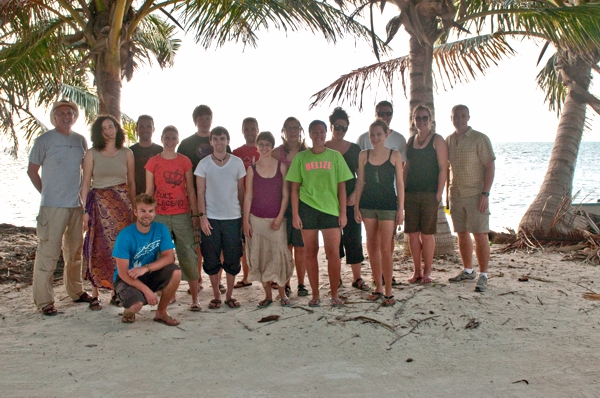 When possible ( blasted pandemics!), I participated in my department’s field course to Belize, Central America that I started along with colleague Jacqueline Sorensen (how can a project by two Danes go wrong?!?!?). This course gave undergraduate students exposure to the complexity of resource management in the tropics, although graduate students can take it as well (and students from other universities also have participated). Belize (an amazing country!) was the staging ground for the course, which runs immediately after the regular winter semester ends at TRU. For more information on the current status of the course, including access to a course outline, visit the Belize field course website or email the Department of Natural Resource Sciences.